Torres de Quart
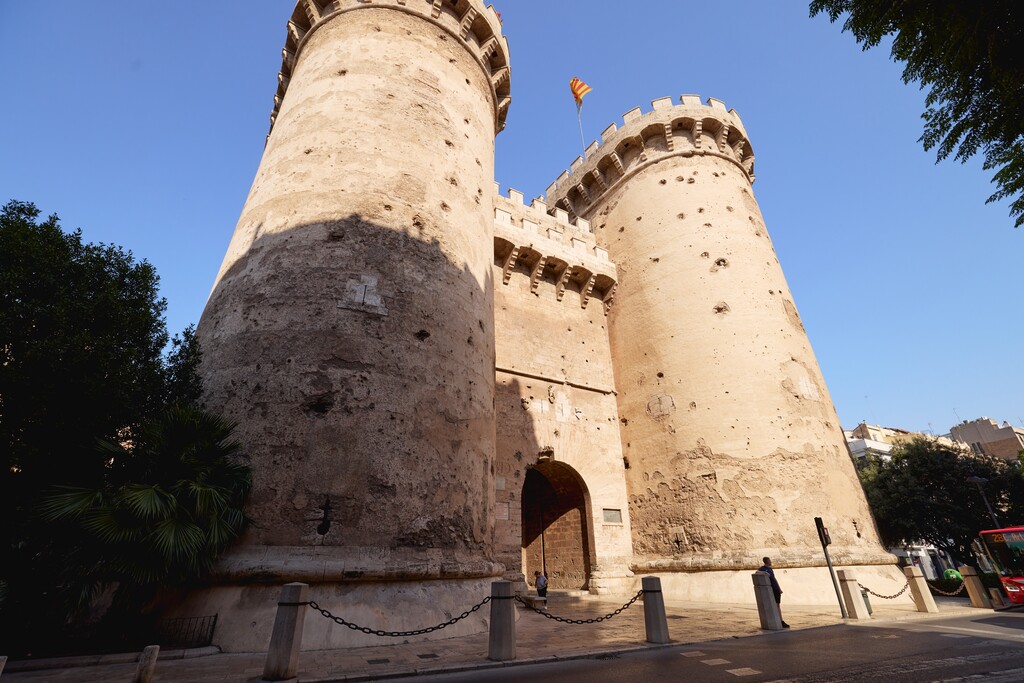
Gate of the Christian city wall built between 1441 and 1460, still bearing the marks of the French bombardment of 1808 on its towers.
- Opening hours
- Mon-Sat 10:00-19:00 · Sun and public holidays 10:00-14:00 · Last entry 30 min before closing
- Where
-
Plaza Santa Úrsula, 1, 46003 València
Valencia
See it on the map ↗ Get directions ↗
What you will see
The Torres de Quart were one of the gates of the Christian city wall of València. They were built between 1441 and 1460 over an earlier gate, modelled on the Castel Nuovo in Naples, which Alfonso the Magnanimous had constructed. The building has three levels: two cylindrical towers of mortar resting on a sloped base, and between them a rectangular section with the gate itself, a semicircular stone arch.
What stands out most is on the surface: the outer render preserves the marks of the bombardment during the French siege of 1808, and a colony of parrots uses these holes to nest. The towers also served as a prison: in 1623 the Consell converted them into a women's prison, and from 1813 to 1932 they were a military jail. For a long time they were known as the Torres de la Cal (Lime Towers), because in the 18th century the lime entering the city had to pass through this gate.
Cost
General admission for those over 16 costs €2. Students, those over 65, pensioners, holders of the Carnet Joven and large or single-parent families pay €1. Children under 16 with a companion, unemployed persons and persons with disabilities enter free.
Opening hours
Monday to Saturday, 10:00–19:00, and Sundays and public holidays, 10:00–14:00. You can enter up to half an hour before closing. Closed on 1 and 6 January, 1 May and 25 December. Visits depend on natural light and may be suspended due to rain, fog or strong wind.
How to get there
The address provided by the town hall is plaza de Santa Úrsula, 1 (46003 València).
Worth visiting if…
…you are interested in seeing history written in stone: here the impacts of 1808 remain visible. If you have already been up the Serranos towers, these are from another century and another design, so the comparison makes sense.